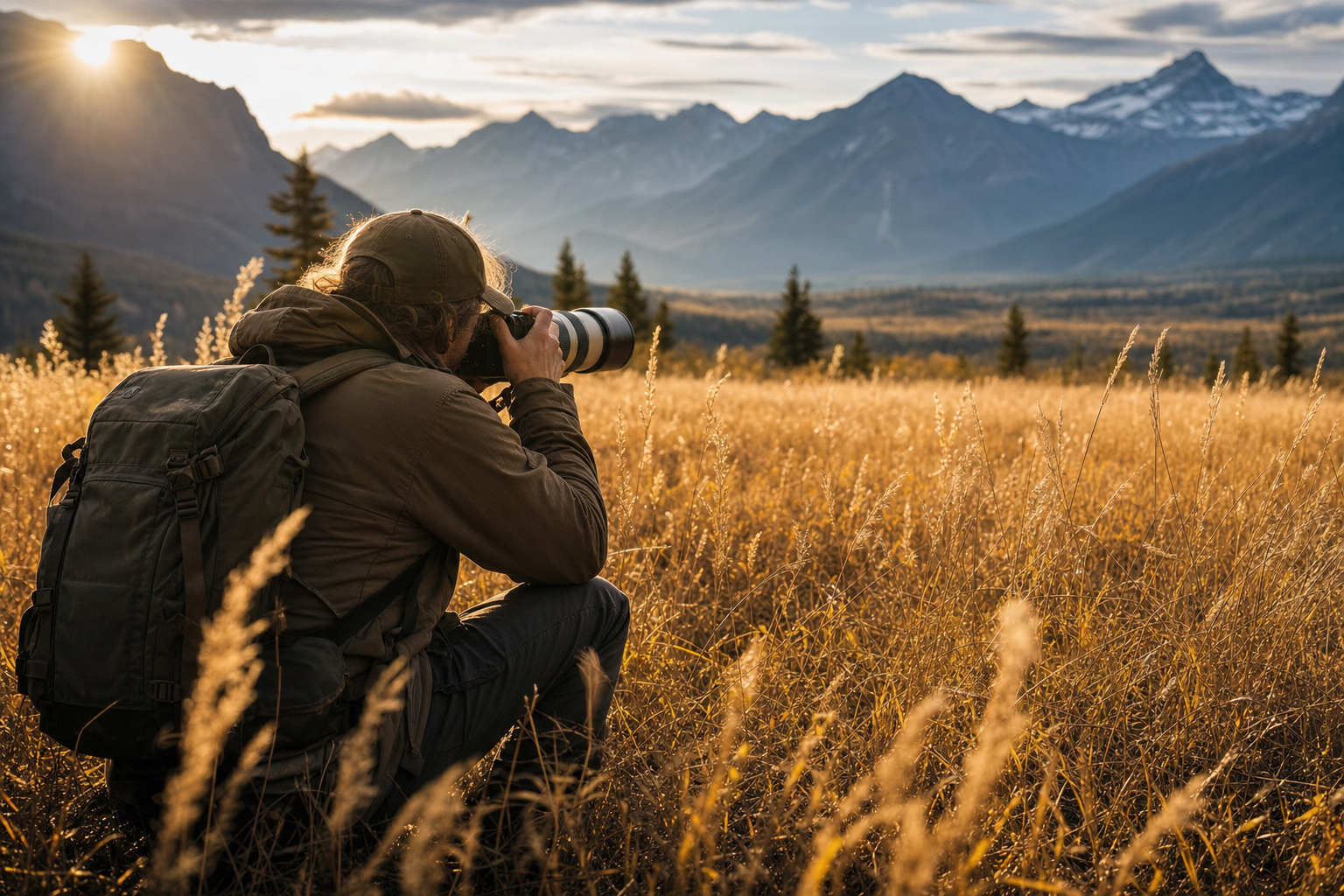
Wildlife Photography Field Guide: Techniques, Equipment & Ethics
Wildlife photography is simultaneously one of the most technically demanding and the most ethically complex branches of photography.
It requires a command of camera systems and optics, an understanding of animal behaviour, a willingness to spend hours or days in field conditions,
and a personal framework for making judgements about when proximity becomes intrusion.
This field guide covers the core competencies of wildlife photography from the ground up:
equipment selection and camera technique, reading animal behaviour, fieldcraft and finding wildlife,
the legal and ethical frameworks that govern photography in national parks and wild areas,
and post-processing workflows. The principles apply broadly but the examples draw specifically on
North American wildlife and the national parks and wild areas covered in The Grizzlar's other journals.
Equipment: What You Actually Need
The camera body matters less than the lens. Modern mid-range mirrorless cameras from any of the major manufacturers
— Canon, Sony, Nikon, Fujifilm — produce results that would have been inconceivable with professional equipment a decade ago.
The autofocus systems in current bodies track moving animals through dense vegetation at burst rates that older systems could not achieve.
For most purposes, a recent mirrorless body with animal-eye tracking is the correct starting point.
The lens choice is the central investment decision. The practical minimum for most large mammal photography is 300mm;
400mm is a more comfortable working focal length. For birds in flight or distant animals, 500–600mm is standard among working photographers.
Super-telephoto primes (500mm f/4, 600mm f/4) deliver the best image quality but are heavy and expensive —
zoom lenses covering 100–400mm or 150–600mm represent a better balance of reach, weight, and cost for most travellers.
Approximate Subject Coverage at 15 m — Selected Focal LengthsEmbed this infographic
<a href="https://www.thegrizzlar.com/wildlife-photography/" title="Focal Length Field of View — The Grizzlar">Focal Length vs Field of View, Wildlife Photography (The Grizzlar)</a>
Camera Technique for Wildlife
Exposure in wildlife photography is almost always a compromise between shutter speed (to freeze motion), aperture (for depth of field
and light gathering), and ISO (for overall exposure). The priority hierarchy for most wildlife situations:
Shutter speed first — motion blur from an inadequate shutter speed is unrecoverable. For a large running bear at 400mm, 1/1600s or faster is typical.
Aperture for light gathering — shoot wide open (f/4 or f/5.6) for maximum light capture. Depth of field is rarely a constraint when subjects are at distance.
ISO as a variable — let Auto ISO compensate. Modern cameras handle ISO 3200–6400 cleanly; ISO 12800 is acceptable for critical moments.
Animal-tracking autofocus on current mirrorless cameras has made focus acquisition substantially easier, but manual focus point selection
remains important for cluttered environments. Understanding the difference between eye-tracking, subject-tracking, and zone AF modes,
and when to switch between them, is central to consistent results.
Ethics and Wildlife Welfare
The ethical responsibilities of wildlife photographers extend beyond legal compliance with park regulations.
The core principle is that the subject's welfare takes precedence over the image.
Behavioural indicators of disturbance include: direct eye contact with the photographer, raised hackles or piloerection,
alarm calls, cessation of feeding, movement away from the photographer, or aggressive displays.
Any of these signals means the photographer is too close. The correct response is to stop, lower the camera,
and either remain still until the animal relaxes or withdraw slowly.
Playback of bird calls to attract species, baiting mammals with food, and using drones to flush birds from cover
are examples of techniques that are ethically problematic regardless of their legal status.
Professional standards increasingly hold that compelling images obtained through animal disturbance are not publishable.
Bears deserve particular consideration. A bear conditioned to approach humans — whether through intentional baiting or
repeated habituation by photographers — faces a substantially higher risk of human-conflict mortality.
Maintaining the minimum 100 m legal distance from bears is not a conservative position; it reflects the minimum
acceptable standard, and many situations warrant greater distance.
See the Bear Safety guide for the full framework.
The best wildlife photographs reward patience, not proximity. The lens brings the animal to you — the animal should never know you are there.
Top Locations for Wildlife Photography in North America
Some locations combine reliable wildlife presence, good habitat visibility, and ethical access conditions that make them
consistently productive for photographers. This is not an exhaustive list — it reflects sites where the conditions
that matter most converge.
Lamar Valley, Yellowstone (WY)
Open topography with reliable wolf, bison, and grizzly presence. Dawn is best. Spotting scopes allow evaluation before committing to a shooting position.
Knight Inlet, British Columbia
Platform-based grizzly photography over salmon streams in September. Close distances in controlled conditions with professional guides.
Brooks Falls, Katmai NP, Alaska
Salmon-fishing bear photography from a fixed viewing platform. July and September are peak periods. Advance reservations through the NPS are essential.
Icefields Parkway, Banff/Jasper (AB)
Some of the most accessible roadside grizzly, bighorn sheep, and elk photography in North America. Spring (late May) is the most productive period.
Boundary Bay, BC
Premier shorebird and raptor photography site. Short-eared owls hunting over the dykes in winter are a particular draw.
Churchill, Manitoba
World-class polar bear photography in October–November. Tundra vehicles provide stable shooting platforms at close range.
What focal length do I need for wildlife photography?
A minimum of 300mm is generally necessary for larger mammals; 400–600mm is preferred. For birds, 500mm or longer is standard. Super-telephoto lenses (500mm f/4, 600mm f/4) produce the best results but are expensive. Teleconverters can extend reach at a cost of maximum aperture and some sharpness.
What camera settings should I use for wildlife photography?
Use Shutter Priority (Tv/S mode) or Manual. Aim for a minimum shutter speed of 1/focal length to prevent camera shake — for a 500mm lens, 1/500s minimum. For moving animals, 1/1000s or faster is often necessary. Use Auto ISO within a set maximum (ISO 3200–12800 depending on your camera). Wide apertures (f/4–f/5.6) blur backgrounds and allow faster shutter speeds.
How close can I get to wildlife for photography?
Parks Canada and the NPS require a minimum of 100 m from bears and wolves, and 25 m from other wildlife. Beyond legal requirements, professional wildlife photographers use distances where the animal shows no behavioural response to their presence — often considerably further than the legal minimum.
Is it ethical to bait wildlife for photography?
Baiting wildlife — placing food to attract animals for photography — is widely condemned by professional wildlife photographers and illegal in most national parks. It conditions animals to associate humans with food, which almost always ends badly for the animal. Captive or baited animal photography in staged settings is increasingly flagged by ethical photo agencies and publications.
What is the best camera for beginner wildlife photography?
Current mirrorless systems from Canon (R7, R5), Sony (a9III, a7RV), and Nikon (Z8, Z9) lead the category for autofocus performance. The Canon R7 or Sony a6700 offer excellent wildlife AF capability at a lower price point. Paired with a 100–400mm zoom, either makes a capable beginner wildlife setup.
What time of day is best for wildlife photography?
The golden hour — the first hour after sunrise and the last hour before sunset — provides the best light quality and the highest wildlife activity. Many mammals are crepuscular (most active at dawn and dusk), making early morning and late afternoon sessions the most productive.
How do I photograph bears without disturbing them?
Maintain distance (minimum 100 m), use long telephoto lenses, approach from downwind, move slowly and minimize noise, and never position yourself between a bear and food, cubs, or an escape route. If a bear changes its behaviour in response to your presence, you are too close.
Should I use a tripod for wildlife photography?
A sturdy tripod or gimbal head is essential for long telephoto lenses (400mm+). A beanbag over a car window provides excellent support and is quieter than a tripod for roadside shooting. A monopod is a useful compromise when mobility matters. Image-stabilized lenses reduce but do not eliminate the need for camera support.
What memory cards should I use for wildlife photography?
Use UHS-II or CFexpress cards with current high-speed camera bodies. Sustained write speed matters more than peak read speed for burst photography. Back up cards immediately in the field — do not rely on a single card for entire trips.
How do I find wildlife to photograph?
Successful wildlife finding requires research before arrival: studying habitat maps, seasonal movement patterns, and park-specific wildlife reports. On the ground, early mornings, field sign (tracks, scat, digging), and talking with park rangers and local naturalists are the most reliable methods.
What post-processing software is best for wildlife photography?
Adobe Lightroom Classic is the industry standard for cataloguing and processing wildlife images. Capture One offers superior colour handling. Adobe Photoshop is essential for more complex compositing. Topaz DeNoise AI and Sharpen AI are widely used for noise reduction and sharpening.
Can I photograph wildlife from a vehicle?
Yes — and for most wildlife, a vehicle serves as an effective blind. Many animals are significantly less alarmed by vehicles than by humans on foot. Roadside photography from a car window (using a beanbag or window mount) is both legal in most parks and often the safest approach for photographers.
What is the ethical maximum drone altitude near wildlife?
Drone use is prohibited in most North American national parks. Where drones are permitted, operators must comply with Transport Canada and FAA regulations, maintain visual line of sight, and avoid disturbing wildlife. Drones flushing nesting birds or causing bears to flee active foraging areas can have serious ecological consequences.
How important is camouflage for wildlife photography?
Camouflage is less important than movement, noise, and scent for most wildlife. Neutral, earth-tone clothing reduces visual contrast, but most mammals navigate primarily by smell and sound. Moving slowly, staying downwind, and using terrain and vegetation for cover are more effective than camouflage patterns.
What makes a great wildlife photograph?
Technical sharpness, appropriate depth of field, good light, and a clean background are baseline requirements. The best wildlife images also capture authentic behaviour — hunting, courtship, confrontation, rest — at the decisive moment. Patience and time in the field, more than equipment, is the primary determinant of image quality.