Bear Safety and Backcountry Preparation: The Complete Guide
Every year, tens of millions of people travel safely through bear country in national parks, wilderness areas,
and backcountry regions across North America. Bear encounters — and especially bear attacks — are statistically rare events.
But when they occur, the outcome is largely determined by preparation and decision-making in the moments before and during the encounter.
This guide synthesizes the current research on bear behaviour, the evidence on deterrent effectiveness, and the practical protocols
recommended by Parks Canada and the US National Park Service. It covers bear spray, food storage, camp design, trail technique,
and encounter response — the complete framework for safe travel in grizzly and black bear country.
Bear Spray vs. Firearms — Effectiveness in Bear Encounters (North America 1987–2006)Embed this infographic
<a href="https://www.thegrizzlar.com/bear-safety/" title="Bear Spray Effectiveness — The Grizzlar">Bear Spray vs Firearms Effectiveness (The Grizzlar)</a>
Bear Spray: The Primary Safety Tool
The research evidence on bear spray is unambiguous. A 2008 study by Smith, Herrero, DeBruyn, and Wilder,
published in the Journal of Wildlife Management, examined 83 incidents in which people used bear spray during bear encounters in Alaska.
The spray was effective in stopping a charge or aggressive behaviour in 92% of cases. Injuries occurred in 28% of incidents but were
substantially less severe than in encounters resolved by other means. No fatalities occurred in spray-use cases in the study period.
Bear spray works by creating a capsaicin cloud that affects the bear's eyes, nose, and respiratory tract —
the most sensitive sensory organs in an animal that navigates primarily by smell.
The correct deployment technique: remove the safety clip, aim slightly downward at approximately a 30° angle,
and deploy in a sweeping motion when the bear is within 7–9 m. Do not deploy into wind; the spray will affect you.
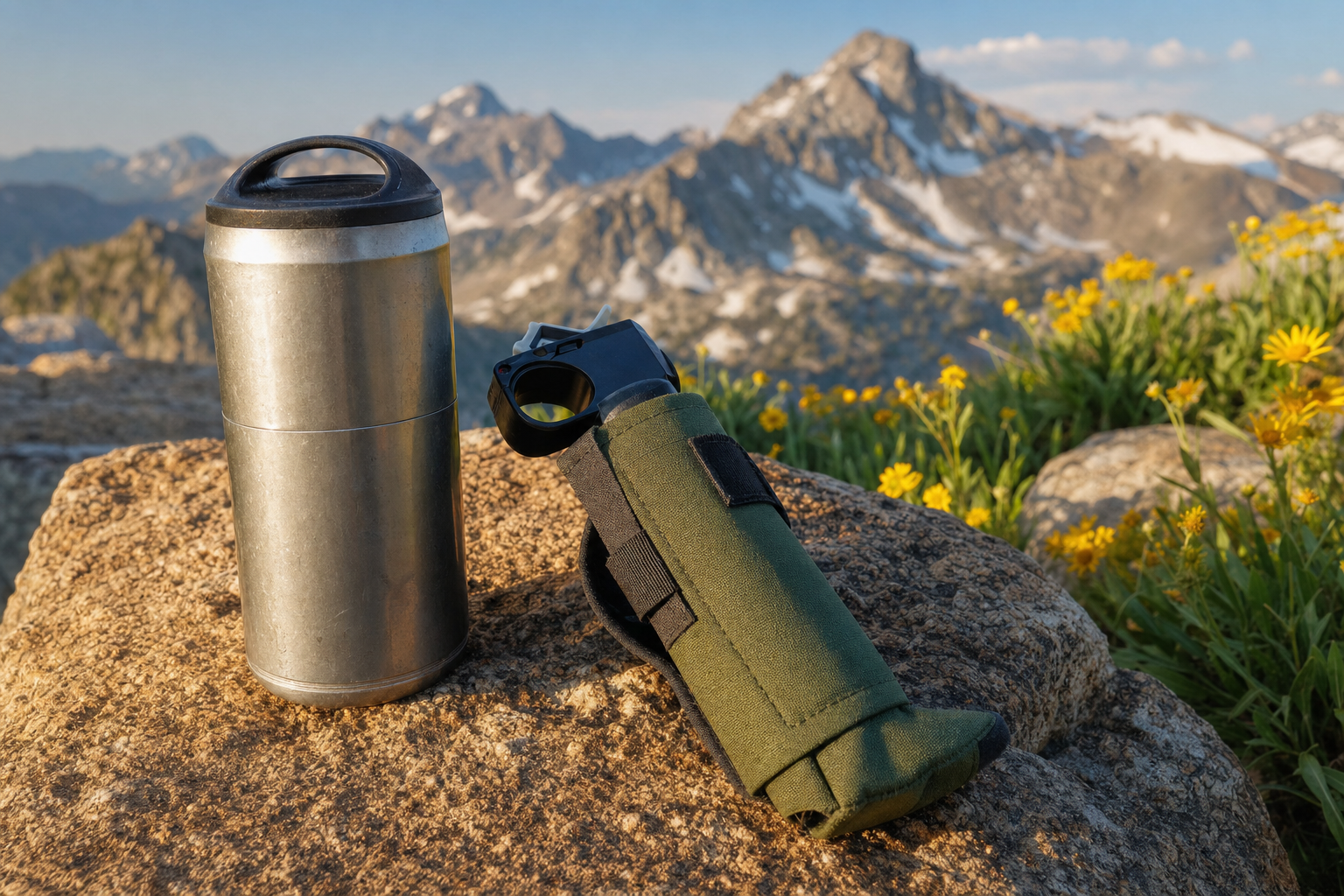
Bear spray should be carried in a hip holster or chest harness strap — accessible with one hand, not buried in a pack.
Check the expiry date before every trip; capsaicin degrades over time. Do not store bear spray in extreme heat (vehicles in summer).
Making Noise on the Trail
Most grizzly bear charges are defensive — triggered by a bear that was surprised at close range and perceived a threat.
The most effective prevention is ensuring that bears are aware of your presence far enough in advance to avoid the encounter entirely.
Active noise-making — calling out, clapping, talking loudly — every 30–60 seconds on trails with limited visibility (dense vegetation, near streams,
wind noise) dramatically reduces the probability of a surprise encounter. Groups of three or more hikers are significantly less likely to be charged
than solo travellers. A study of bear attacks in Yellowstone found that solo or paired hikers accounted for the vast majority of incidents.
Food Storage and Camp Hygiene
A bear that obtains food from a camp or campsite will return. Food-conditioned bears pose an escalating risk to subsequent visitors
and frequently result in bear management actions — relocation or, when relocation fails, lethal removal.
The phrase used by wildlife managers — "a fed bear is a dead bear" — reflects a real and consistent pattern.
All food, drink, and scented items (including toiletries, sunscreen, insect repellent, and garbage) must be stored in a
hard-sided bear canister, an approved bear box, or hung at the "PCT hang" standard: 4 m above ground and 3 m from the trunk,
using a tree at least 6 m from the sleeping area. Cook at a minimum of 60 m downwind from sleeping areas.
Proper food storage is not optional in bear country. It protects you, the next camper, and — most importantly — the bear.
Encounter Response Protocols
Bear encounters fall into several categories that require different responses. Correctly identifying the situation determines the appropriate action.
Bear at distance, unaware of you
Give it space. Observe from a safe distance. Do not approach. Allow it to move off naturally if it is on your planned route.
Bear becomes aware of you at moderate distance
Stop. Identify yourself as human by speaking calmly. Back away slowly. Do not run. Give the bear a clear escape route.
Bear charges — defensive (surprised bear, mother with cubs)
Stand your ground. Deploy bear spray when bear is within 7–9 m. If contact occurs: play dead — face down, legs spread, hands over neck. Remain still.
Bear charges — predatory (follows or stalks first)
Fight back aggressively. Target eyes and nose. Use any available object. Do not play dead — this bear is hunting, not defending.
Black bear attack
Always fight back. Black bear attacks are almost always predatory, even when the bear appears defensive. Target face and muzzle.
For context on bear species identification — distinguishing grizzly from black bear in the field — see the
Grizzly Bears species guide.
For wildlife photographers requiring safety guidance specific to their fieldwork, see the
Wildlife Photography Field Guide.
Frequently Asked Questions
Is bear spray effective against grizzly bears?
Yes. Multiple peer-reviewed studies confirm that bear spray is more effective than firearms at stopping grizzly bear charges. A 2008 study by Smith et al. in the Journal of Wildlife Management found bear spray stopped charging bears in 92% of encounters. It creates a cloud barrier that affects a charging bear's respiratory system and eyes without requiring precise aim.
How far does bear spray shoot?
Most certified bear sprays have a range of 7–9 m (23–30 ft). The spray should be deployed when a bear is within this range and charging directly toward you, aiming slightly downward into the approaching bear's face.
Should I play dead or fight back during a bear attack?
It depends on the type of attack. For a defensive grizzly attack (surprised bear, bear with cubs): lie face down, legs spread, hands clasped over neck, and play dead. Remain still until the bear leaves. For a predatory attack (a bear that stalks or attacks at night): fight back aggressively with any available tool. Black bear attacks are almost always predatory — always fight back.
How do I store food safely in bear country?
Use a hard-sided bear canister (required in many backcountry areas), a park-approved bear box, or hang food at least 4 m (13 ft) off the ground and 3 m (10 ft) from the nearest tree trunk. Store all scented items — food, trash, toothpaste, sunscreen, lip balm, cooking equipment — away from your sleeping area.
What should I do if I encounter a bear on the trail?
Stop. Identify yourself as human by speaking calmly in a low voice. Assess the situation — is the bear aware of you? Give the bear space and a clear escape route. Back away slowly, facing the bear. Do not run. If the bear approaches, hold your ground, speak firmly, and be ready to use bear spray.
How can I reduce the risk of a bear encounter on the trail?
Make noise while hiking — clapping, calling out, or using a bear bell. Avoid hiking at dawn, dusk, and night when bears are most active. Stay on designated trails. Hike in groups of three or more. Keep dogs on leash. Avoid areas with fresh bear sign (tracks, digging, scat, claw marks on trees).
Do bear bells work?
Bear bells are less effective than regularly talking, clapping, or calling out. Their small size limits acoustic range, and bears in windy terrain or near running water may not hear them at a useful distance. Use bear bells as a supplement to active noise-making, not as a replacement.
Is it safe to cook in a bear country campsite?
Yes, with proper protocols. Cook at least 60 m from your sleeping area. Do not cook near streams or water sources that bears use. Change clothes after cooking and store your cooking clothes with food and scented items. Clean all cooking equipment thoroughly before sleeping.
Can I hike in bear country with a dog?
Dogs are permitted on leash in many national park frontcountry trails but are prohibited on most backcountry trails. An off-leash dog that encounters a bear may return to its owner with the bear in pursuit. Keep dogs on a short leash (maximum 2 m) at all times in bear country.
What does a bluff charge look like and how do I respond?
A bluff charge stops short of contact, often with the bear veering sideways or stopping abruptly. Stand your ground — running triggers the pursuit instinct. Hold bear spray ready and deploy it if the bear continues within range. Shouting firmly may cause a bluff-charging bear to divert.
Should I carry bear spray even in a national park?
Yes. Bear spray is recommended or required in all bear country, including national parks. Parks Canada and the NPS recommend it as the primary personal safety tool. It should be carried in a holster on your hip or chest strap — not in your pack — for immediate deployment.
What is the correct way to use a bear canister?
Place all food, scented items, and garbage in the canister before camp and close it securely. Store the canister at least 60 m from your tent, on flat ground away from cliff edges (bears roll them). Do not attach the canister to your pack — place it where it will not roll into a river or fall off a ledge.
Are electric fences effective at protecting camps from bears?
Yes. Portable electric fences are highly effective at deterring bears from campsites, particularly in areas with habituated bears. They are increasingly used by researchers and outfitters in bear-dense areas. A properly installed fence significantly reduces the risk of food raids and bear-camp interactions.
What should I do if a bear enters my camp at night?
Make noise immediately — this is almost certainly a food-conditioned bear, and noise may cause it to leave. Do not leave your tent to confront it. Have bear spray accessible inside your tent. If the bear makes contact with your tent or attempts to enter, fight back aggressively — this is a predatory scenario requiring active defence.
How do I recognize fresh bear sign on the trail?
Fresh bear sign includes: scat that is warm, moist, or contains recognizable food (berries, seeds); digging in turf or around ground squirrel burrows (grizzlies leave characteristic large cone-shaped excavations); claw marks or hair on trees at bear-rubbing posts; large flattened circular rest sites in tall grass; fish remains near streams.
What is the difference between a defensive and a predatory bear attack?
A defensive attack is triggered when a bear is surprised at close range, defending cubs, or protecting a food source. It is usually intense but brief, and playing dead (for grizzlies) is often the correct response. A predatory attack is characterized by a bear that has been watching or following the person before approaching. It is quieter, more deliberate, and requires active defence.