Grizzly Bears and Salmon: The Critical Autumn Fishing Season Explained
How salmon runs transform grizzly bear behaviour and body condition each autumn — plus the BC and Al…

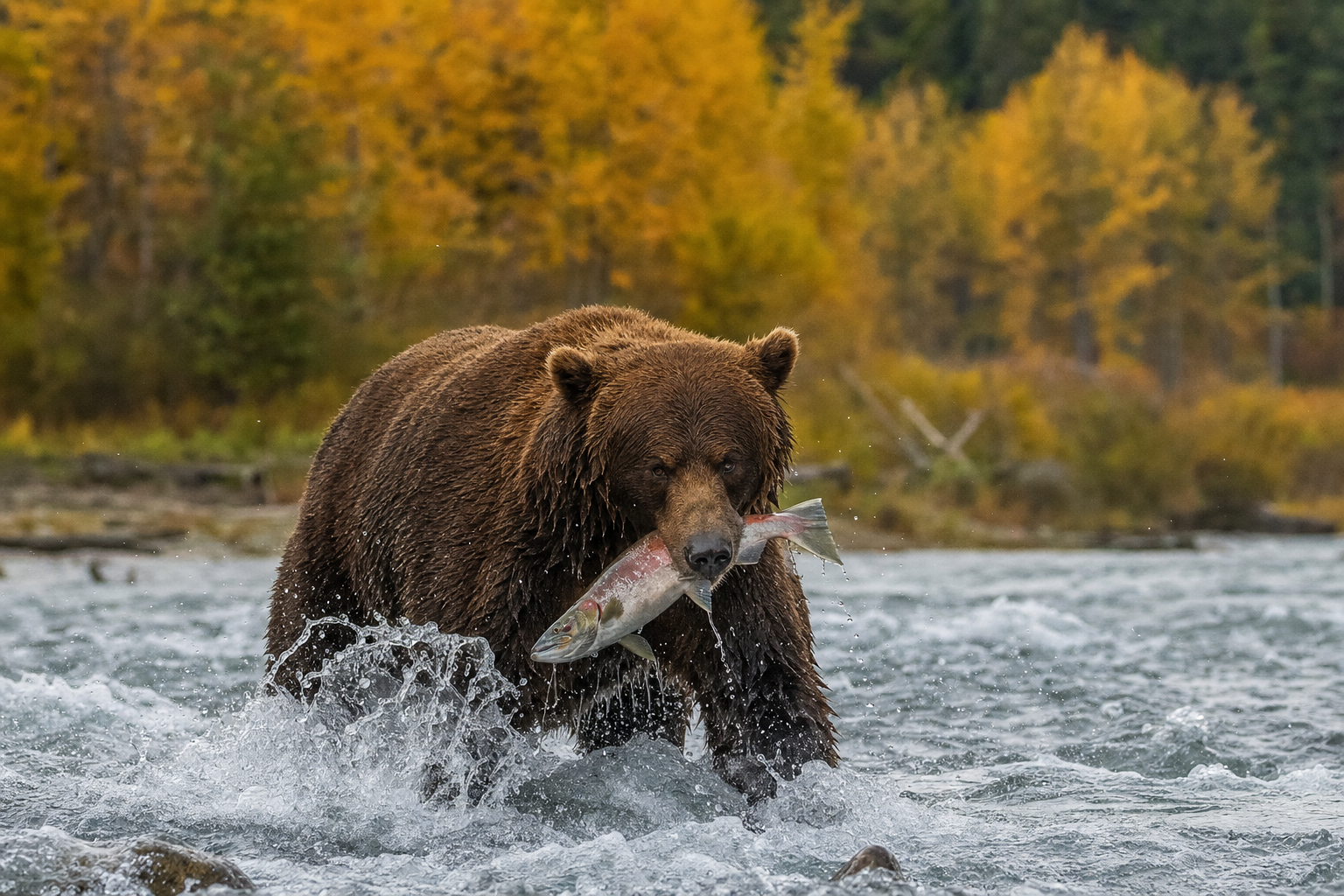
The grizzly bear (Ursus arctos horribilis) stands at the apex of North America's mountain and boreal ecosystems. Few animals carry as much ecological weight — or generate as much cultural and political debate — as this iconic brown bear. From the salmon rivers of coastal Alaska to the high alpine meadows of Banff National Park, grizzlies shape the landscapes they occupy in ways that ecologists are still working to fully measure.
This guide covers the grizzly bear in depth: its taxonomy and physical characteristics, the full range of its North American distribution, its dietary ecology through the seasons, its reproductive biology, the threats it currently faces, and where and how to encounter this species safely in the wild. Internal links throughout connect to deeper field reports on specific topics, parks, and regions covered in The Grizzlar's other journals.
The grizzly bear is a subspecies of the brown bear, one of the most widely distributed land carnivores on Earth. The name horribilis — Latin for "horrible" or "dreadful" — was assigned by the naturalist George Ord in 1815, a reference to the species' formidable size and temperament rather than to any aesthetic judgement.
Distinguishing a grizzly from a black bear (Ursus americanus) in the field is essential for safety. Key field marks include the prominent shoulder hump — a mass of muscle used for digging — the dished facial profile, shorter and more rounded ears compared to black bears, and long, curved front claws often pale in color. Coat color ranges from pale blonde to near-black, so coloration alone is not a reliable identifier.
Coastal brown bears — including the Kodiak bear (U. a. middendorffi) — are sometimes treated as distinct subspecies. They are generally larger than interior grizzlies owing to the protein-rich salmon runs available to them each autumn. A mature coastal male can reach 500 kg, roughly 40% heavier than a typical Rocky Mountain grizzly.
Grizzly bears once ranged across much of North America, from the Pacific coast east to the Great Plains and south into central Mexico. European settlement and the associated hunting, trapping, and land conversion that followed reduced this range by roughly 98% in the contiguous United States over 200 years.
Today, significant grizzly populations persist in six recovery ecosystems in the contiguous US — most notably the Greater Yellowstone Ecosystem and the Northern Continental Divide Ecosystem of Montana — and across much of British Columbia, Alberta, the Yukon, Northwest Territories, Nunavut, and Alaska.
In Canada, the provinces of British Columbia and Alberta hold the most substantial southern populations. BC estimates range upward of 15,000 bears; Alberta's population is smaller, approximately 700–900 animals, concentrated in the Rocky Mountain foothills and the Willmore Wilderness Park corridor north of Jasper.
Grizzly bears are the most omnivorous large predators in North America, with diets that shift dramatically by season, elevation, and regional food availability. Understanding this dietary ecology is fundamental to understanding where and when bears are likely to be encountered.
Spring emergence (April–May) finds bears in a nutritionally depleted state after months of torpor. They target vegetation just emerging from snowmelt — sedges, horsetails, and dandelions — as well as ungulate carcasses that did not survive the winter. Insects, particularly overwintering moths in talus slopes, can be a key high-calorie source in some populations.
Summer brings a diversification of plant food: berries (huckleberry, serviceberry, buffaloberry), roots and tubers, ungulate calves taken opportunistically, ground squirrels, and in many BC and Alaska populations, a significant contribution from salmon. Hyperphagia — the intense pre-hibernation feeding phase — typically peaks in August–October, when bears may consume 20,000 calories per day.
Autumn caloric intake is dominated by whitebark pine nuts in the Rockies (a food source increasingly threatened by white pine blister rust and mountain pine beetle), berries, and salmon in coastal populations. Bears that can access salmon streams gain weight significantly faster than inland bears relying on berries alone — a critical factor for reproductive females.
Grizzly bears have one of the lowest reproductive rates of any North American mammal, which is central to understanding why populations recover slowly from losses. Females reach sexual maturity at 4–7 years, depending on food availability. Mating occurs in late May through July, but implantation is delayed until autumn — a reproductive strategy called embryonic diapause — ensuring that young are born only if the mother has achieved sufficient fat reserves.
Litters of 1–4 cubs (most commonly 2) are born in the winter den, typically in January or February, while the mother remains in torpor. Cubs weigh approximately 500 g at birth and emerge from the den in April with their mother. The mother–cub family unit is the most cohesive social bond in grizzly society; the sow is highly aggressive in defense of her offspring, and maternal aggression is the primary driver of most grizzly attacks on people.
Cubs remain with their mother for 2–3 years. After separation, subadult bears experience a particularly vulnerable period as they establish independent ranges and navigate competition with adult males. Females typically breed only once every 3–4 years, meaning that a single adult female may successfully raise fewer than eight cubs over a 25-year reproductive lifespan.
The conservation trajectory of grizzly bears varies substantially by jurisdiction. In Alaska, populations are generally stable and well-managed. In the Greater Yellowstone Ecosystem, a long-running recovery effort has brought the population from fewer than 150 animals in 1975 to an estimated 700+ today — widely considered one of the most successful large-carnivore recoveries in North American history.
In Alberta, the situation is considerably more precarious. The provincial grizzly population has been assessed as Threatened at the provincial level, with road networks, energy development, and human-caused mortality representing the primary drivers of population decline. Research by the Eastern Slopes Grizzly Bear Project over three decades has documented the central role of roads in fragmenting habitat and increasing encounter rates that lead to conflict and mortality.
Climate change represents an emerging threat across all populations. Whitebark pine, a critical autumn food in the Rockies, has declined by up to 80% in some areas due to blister rust and mountain pine beetle infestation — both conditions exacerbated by warming temperatures. Changes in snowpack timing affect plant phenology, alter the timing of salmon runs, and compress the hyperphagia window that bears depend on to survive winter.
For more on landscape connectivity and wildlife corridors, see the Canadian Wilderness Journal. Visitors to grizzly country should also consult the Bear Safety Guide before venturing into the backcountry.
Responsible wildlife viewing requires distance, preparation, and respect for the animal's behaviour. The following locations are among the most reliable for grizzly bear observation in North America.
Guided viewing platforms above salmon streams. September–October viewing of bears fishing is among the best on the continent.
Canada's only protected area established specifically for grizzly bear conservation. Boat-based and guided access only.
Roadside sightings common in early morning and evening. The Icefields Parkway corridor is particularly productive in late spring.
The park's single road transects prime grizzly habitat. Bear sightings are reliable from the bus, which is the primary means of access.
Brooks Falls is world-famous for bear salmon-fishing, with a viewing platform operated by the NPS. Accessible in July and September.
The Lamar Valley in Yellowstone National Park offers some of the most accessible open-country grizzly viewing in the lower 48.
For planning details on specific parks, see the National Parks planning guide. Wildlife photographers seeking advice on approaching bears safely and ethically can consult the Wildlife Photography Field Guide.
How salmon runs transform grizzly bear behaviour and body condition each autumn — plus the BC and Al…
Grizzly bear conservation in Canada and the US — population counts, recovery zones, key threats, and…
Grizzly bear habitat across North America — Pacific coast rainforests, high Alaskan tundra, and moun…