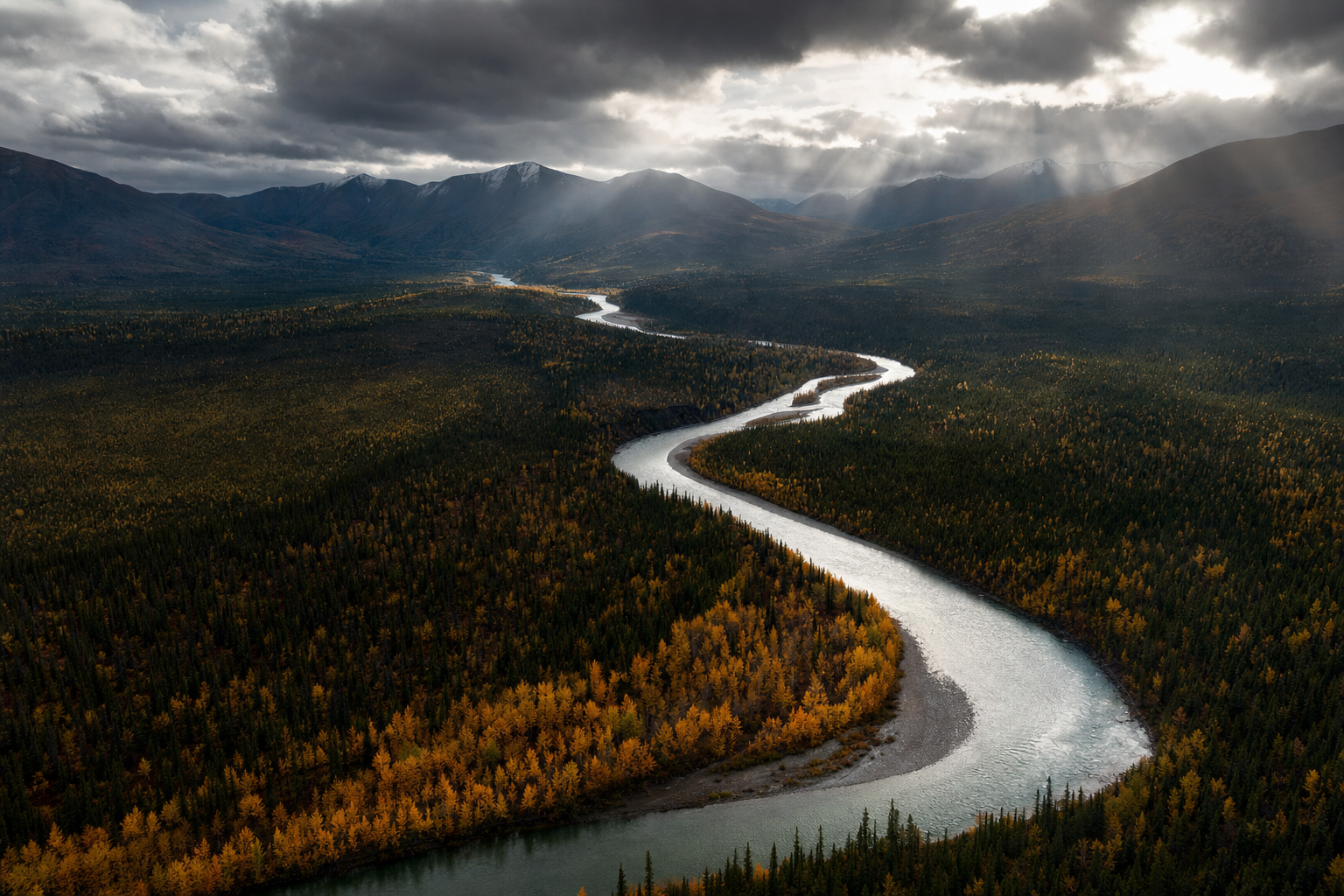
Canada's Wilderness: Wild Areas, Routes, and Wildlife of the North
Canada holds roughly 9% of the world's freshwater, 25% of its wetlands, and the largest intact boreal forest remaining on Earth.
These numbers have become so familiar that they risk losing their weight. To understand what they mean in practice,
one needs to stand at the edge of a unnamed lake in the Yukon interior and realize that the watershed draining into it
has never been mapped at the scale of a footprint.
This guide covers the major wilderness regions of Canada: the ecology, wildlife, access logistics, and conservation context
of each area. It is intended for travellers, naturalists, wildlife enthusiasts, and anyone planning a journey into Canada's
less-visited wild country. For readers interested in grizzly bears specifically, the
Grizzly Bears journal covers this species in depth.
For safety guidance specific to bear country, see the Bear Safety guide.
Key Wilderness Regions — Overview
Region
Province/Territory
Approx. Area
Key Wildlife
Great Bear Rainforest
BC
6.4M ha
Spirit bear, grizzly bear, wolves, salmon
Yukon Wilderness
YT
~47M ha
Grizzly bear, Dall sheep, moose, Chinook salmon
Canadian Arctic Archipelago
NU
1.4M km²
Polar bear, musk ox, Arctic wolf, beluga
Labrador Interior
NL
~28M ha
Woodland caribou, black bear, wolf, osprey
Rocky Mountain Wilderness Corridors
AB/BC
~5M ha
Grizzly bear, wolverine, mountain caribou, wolf
Boreal Shield
ON/QC
~600M ha
Black bear, moose, wolf, loon, pike
Protected Land Area in Canada — By Designation Type (2024)Embed this infographic
<a href="https://www.thegrizzlar.com/canadian-wilderness/" title="Protected Areas in Canada — The Grizzlar">Canada Protected Land Area by Designation (The Grizzlar)</a>
The Great Bear Rainforest
The Great Bear Rainforest spans the central and north coast of British Columbia — a 6.4 million hectare stretch of
temperate rainforest, fjords, islands, and salmon rivers that remains one of the largest intact temperate rainforests in the world.
A landmark 2016 land use order provided formal legal protection to 85% of the region and established a framework for
ecosystem-based management across the remainder in partnership with First Nations.
The rainforest's most famous inhabitant is the Kermode or spirit bear — a cream or white-coloured form of the black bear
found on specific islands and adjacent mainland areas. Genetic research has shown that the white colouration, produced by a
recessive variant of the MC1R gene, is maintained in island populations at much higher rates than on the mainland —
up to 20–30% white bears in some populations. The trait may confer a foraging advantage when fishing salmon in daylight.
Grizzly bears are also abundant throughout the Great Bear Rainforest, reaching their highest densities around the
salmon rivers and estuary systems of the coast. Knight Inlet and the Khutzeymateen Grizzly Bear Sanctuary,
north of Prince Rupert, are the primary ecotourism sites for grizzly viewing.
Yukon Wilderness
The Yukon contains approximately 482,000 km² of land of which roughly 20% is formally protected — primarily through Kluane National Park
and Reserve, a UNESCO World Heritage Site and home to one of the world's largest non-polar ice fields.
Beyond the parks, vast stretches of the Yukon remain in a condition of ecological completeness rarely found elsewhere on Earth.
Grizzly bears are abundant and highly visible in the Yukon compared to most of their range farther south,
partly because human presence is minimal and partly because the tundra and alpine terrain provides open sightlines.
Dall sheep occupy the rocky ridges; moose move through valley willow thickets; wolves travel in family groups across the
open terrain; caribou herds undertake some of the longest overland migrations of any terrestrial mammal.
Rocky Mountain Wilderness Corridors
The mountain parks of Alberta and British Columbia — Banff, Jasper, Yoho, Kootenay, and their provincial park neighbours —
form the core of the southern Rocky Mountain protected area network. But between these parks lie critical unprotected corridors:
the Bow Valley west of Canmore, the Crowsnest Pass region, the Willmore Wilderness north of Jasper,
and the varied provincial lands along the eastern slopes of the Rockies.
Grizzly bears, wolves, wolverines, and mountain caribou require these corridors to move between the protected core areas.
The Yellowstone to Yukon Conservation Initiative has identified the primary connectivity pinch-points
and is working with governments, Indigenous communities, and private landowners to maintain passable linkages
through an otherwise fragmented landscape. See the National Parks guide
for detailed coverage of individual parks in this corridor.
Canada's wilderness is not a backdrop — it is a living system in which the parts depend on each other across distances that dwarf the concept of a protected area.
Frequently Asked Questions
What is the Great Bear Rainforest?
The Great Bear Rainforest is a vast temperate rainforest on the central and north coast of British Columbia, covering approximately 6.4 million hectares. It is one of the largest intact temperate rainforests in the world and home to grizzly bears, spirit bears (Kermode bears), wolves, salmon, and an extraordinary diversity of marine and terrestrial wildlife.
What is a spirit bear?
The spirit bear, or Kermode bear, is a rare cream or white-coloured black bear (Ursus americanus kermodei) found in specific areas of BC's north coast, primarily on Princess Royal Island and surrounding mainland areas. The colouration results from a recessive gene and occurs in roughly 10–20% of black bears in the region.
How do I access the Great Bear Rainforest?
Access to the Great Bear Rainforest is primarily by small floatplane or boat. The nearest hubs are Prince Rupert, Bella Bella, and Bella Coola. Licensed eco-tourism operators provide guided access; independent access to remote parts of the rainforest requires substantial wilderness experience and logistics planning.
What wildlife can I see in the Yukon?
The Yukon supports grizzly bears, black bears, Dall sheep, moose, caribou, wolves, wolverine, lynx, mountain goats, Chinook and coho salmon, and abundant bird life including golden eagles, peregrine falcons, and trumpeter swans.
What is the Yellowstone to Yukon Conservation Initiative?
The Yellowstone to Yukon Conservation Initiative (Y2Y) is a collaborative conservation programme aiming to maintain and restore wildlife connectivity along a 3,200 km corridor from Yellowstone National Park in Wyoming to the Yukon. It focuses on grizzly bears, wolves, wolverine, and other wide-ranging species that require large intact landscapes.
How large is Canada's boreal forest?
Canada's boreal forest covers approximately 552 million hectares and represents roughly 28% of the world's boreal biome. It stores more carbon than any other terrestrial ecosystem type and provides critical breeding habitat for billions of migratory birds.
Can I see woodland caribou in Canada?
Yes. Woodland caribou are found across boreal and mountainous regions of Canada, from British Columbia east to Newfoundland and Labrador. They are assessed as Threatened by COSEWIC. Viewing opportunities exist in several provincial and national parks, including Jasper (southern mountain caribou), La Vérendrye in Quebec, and Gros Morne in Newfoundland.
What wilderness areas in Canada have no roads?
Large portions of the Canadian north — most of Nunavut, large areas of the Northwest Territories, northern Quebec, and Labrador — have no road access. The Torngat Mountains National Park in northern Labrador, accessible only by air, is one of the most remote national parks in eastern Canada. Much of the BC and Yukon wilderness is also roadless.
Is it safe to travel solo in Canadian wilderness?
Solo wilderness travel in Canada is possible for experienced travellers with proper equipment and skills, but requires careful planning and risk assessment. Emergency communication devices (satellite messengers, PLBs) are essential. Bear spray is recommended throughout western and northern Canada. Filing a detailed trip plan with a responsible contact is a basic safety requirement.
What is the best time of year to visit the Yukon?
Summer (June–August) offers the longest days, the most accessible trails, and the highest wildlife activity. Autumn (September–October) brings fall colours, active salmon runs, and pre-hibernation grizzly bears. Winter offers northern lights viewing and cross-country skiing, but travel requires cold-weather expertise.
What is the Mackenzie River?
The Mackenzie River is Canada's longest river at 4,241 km, draining a basin of approximately 1.8 million km² from the Rockies north to the Mackenzie Delta and the Beaufort Sea. It flows through some of the most remote boreal and subarctic wilderness in North America and is a critical flyway for migratory birds.
Where can I see beluga whales in Canada?
The St. Lawrence estuary near Tadoussac, Quebec, supports a resident population of beluga whales year-round. Churchill, Manitoba, on Hudson Bay, sees large aggregations of belugas in summer (July–August). Other viewing sites include the Cunningham Inlet on Somerset Island in Nunavut, accessible by expedition.
How does the Rocky Mountain wildlife corridor work?
Wildlife corridors are strips of natural habitat connecting otherwise fragmented protected areas, allowing animals to move between them for foraging, breeding, and genetic exchange. In the Canadian Rockies, the primary corridor runs along the eastern slopes of the mountains from Waterton-Glacier north to Willmore Wilderness Park. Grizzly bears, wolves, and wolverines require these corridors to maintain viable populations across the region.
What threatened species live in Canadian wilderness?
Canadian wilderness supports numerous species assessed as Threatened or Endangered by COSEWIC, including grizzly bear (special concern to threatened by province), woodland caribou (threatened), North Atlantic right whale, swift fox (endangered), wolverine (special concern), and various freshwater fish species in western river systems.
What is the difference between old-growth forest and second-growth forest?
Old-growth forest (also called primary forest or ancient forest) has never been logged and contains trees of multiple ages, including very large old trees, standing dead trees (snags), and fallen logs at various stages of decomposition. Second-growth forest has regenerated after logging or disturbance. Old-growth forest provides critical habitat for species including marbled murrelet, spotted owl, fisher, and a wide range of invertebrates that cannot persist in second-growth.